
The State Opening of Parliament is a ceremonial event which marks the formal start of the parliamentary year. It is the only occasion on which the three parts of Parliament – the Monarch, the House of Lords and the House of Commons – meet.
The Monarch’s speech – written by the government – is delivered from the throne in the House of Lords and outlines proposed policies and legislation for the new parliamentary session.
The Modern Ceremony
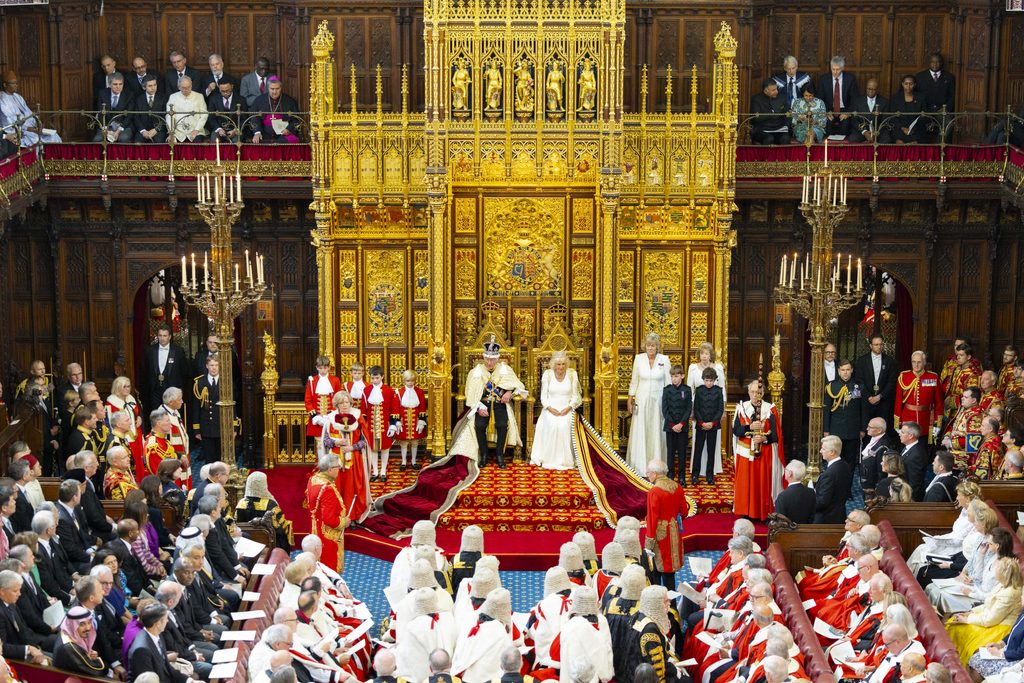
The current State Opening ceremony dates back to 1852 after the rebuilt Palace of Westminster was opened. It takes place on the first day of a new parliamentary session, which usually lasts one year and ends with prorogation – the formal suspension of Parliament.
The ceremony begins with the Monarch’s procession from Buckingham Palace to Westminster. After arriving at the Sovereign’s entrance to the Palace of Westminster, the Monarch proceeds to the Robing Room where they don the Imperial State Crown and the Robe of State.
The Royal procession including members of the Royal Household and other regalia – the Sword of State and the Cap of Maintenance – then heads to the chamber of the Lords.
After the Monarch is seated and delivers the Monarch’s speech, both Houses independently debate the contents of the speech.
Although some key elements have remained the same, the opening ceremony of Parliament has evolved in different ways over the centuries.
Black Rod
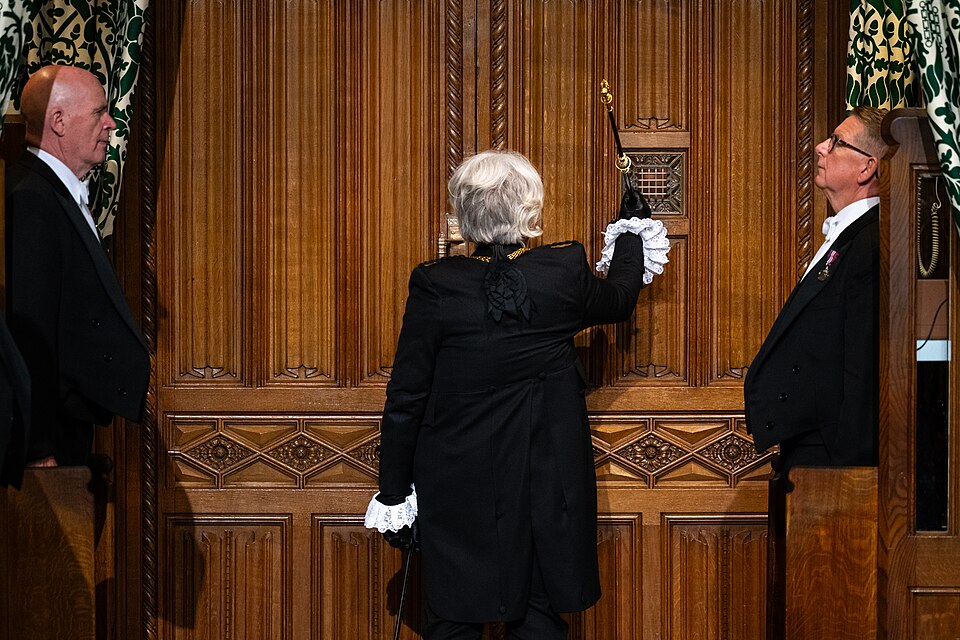
Black Rod has a crucial role in the ceremony. They are a senior officer in the House of Lords with both ceremonial and administrative duties. The Lady or Gentleman Usher of the Black Rod is responsible for maintaining order within the Lords Chamber.
Their role in the State Opening is to summon MPs to hear the Monarch’s speech. However, as part of the ceremony, just before Black Rod enters the Commons chamber, the doors are slammed shut in their face. Black Rod must then knock with their rod before the door is opened.
Once inside Black Rod invites members of the Commons to follow them to stand at the entrance of the Lords chamber to hear the Monarch’s speech: ‘Mr/Madam Speaker, the King/Queen commands this honourable House to attend His/Her Majesty immediately in the House of Peers’.
The ceremony of ‘knocking’ is said to date back to 1642 when Charles I attempted to enter the Commons and arrest five members. By slamming the door in Black Rod’s face, the Commons are said to be asserting their independence from the monarchy. However, there is evidence that may point to the procedure predating this.
The History of the Ceremony
Explore the State Opening over time:
Medieval Period
By the later middle ages, the gathering of any new Parliament was accompanied by a variety of ceremonies. According to the Modus Tenendi Parliamentum (The manner of holding a Parliament), due to the number of administrative tasks required before actual parliamentary deliberations could begin, the King was not actually required to be present until the sixth day of a new Parliament, although he remained involved.
Before the Lords and Commons assembled, a formal proclamation was made in Westminster Hall forbidding anyone unauthorised or below the rank of a baron to come armed to London or the Palace of Westminster, or any children to play silly games such as pulling men’s hoods off their shoulders. The King and the Lords then processed to Westminster Abbey in their Parliament robes to attend mass (a religious service) ahead of the session formally opening. Meanwhile, in the Palace of Westminster’s Parliament Chamber the Lord Steward conducted a roll call of the members of the Commons.
On their return from mass, the King and the Lords took their seats in the Parliament Chamber, and at the Monarch’s bidding the chancellor or a senior member of the clergy preached a sermon setting out the general matters to be put before Parliament. The Commons were then dispatched to their own meeting place to choose a Speaker. This was a less straightforward operation than might appear. Whereas in later centuries the named Speaker was often a royal appointee, the middle ages periodically saw fierce contests for the office.
Speaker of the House
What did the role of the Speaker look like in this period? Find out more here.
Black Rod
How did Black Rod’s role differ in earlier centuries? Find out more here
Tudor and Early Stuart Period
By the reign of Henry VII, the basic pattern for the State Opening of Parliament was already well established: Lords, bishops and MPs gathered to hear the Monarch setting out the reasons for summoning Parliament.
From 1536 Westminster again became the usual location, but in 1553, when Edward VI was ill, the State Opening took place in his apartments at Whitehall Palace. Under Elizabeth I and her successors, it was not unusual for the ceremony to be postponed at short notice.
Whereas nowadays Monarchs ride from Buckingham Palace to Westminster, where the Lords and Commons await their arrival, in early modern times, the peers also took part in the procession, which had two distinct stages. Firstly, a religious service was held to request God’s guidance over Parliament’s proceedings, most commonly at Westminster Abbey.
After meeting in Westminster, the Monarch and Lords walked to the service then returned on foot to the Palace of Westminster. After Henry VII moved to Whitehall Palace it became traditional for the procession to be on horseback. The procession to the Palace has continued, but Mary I, Elizabeth I and an elderly James I preferred to use a coach, much like the current procession.

To learn more about the State Opening procession in early modern England, click here.
Gunpowder Plot
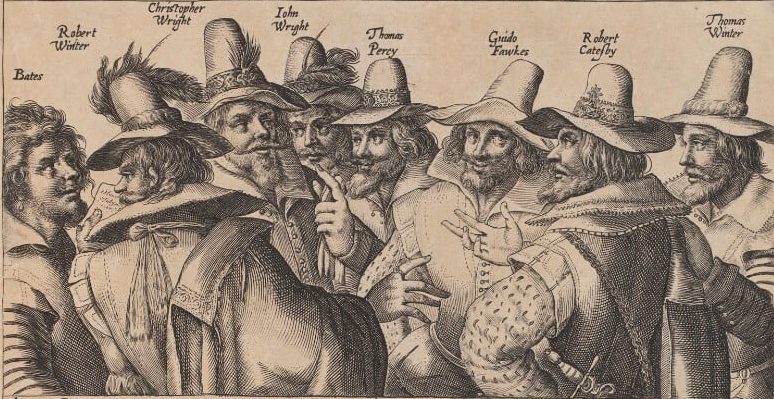
The Gunpowder Plot Conspirators, 1605; Crispijn de Passe the Elder (c.1605); © National Portrait Gallery, London; CC BY-NC-ND 3.0
Did you know that Guy Fawkes and his fellow conspirators chose the day of the 1605 State Opening of Parliament as the target for their infamous Gunpowder Plot?
As the only time when the Monarch, Lords and Commons were in the same place, 5 November presented the opportunity for maximum damage. However, on the night of 4 November, Guy Fawkes was discovered in the cellar below the House of Lords chamber with 36 barrels of gunpowder and was arrested for attempting to kill James I.
This event prompted a ceremony which still takes place today. On the day before each State Opening, the cellars of the Palace of Westminster are inspected by Yeomen of the Guard (otherwise known as Beefeaters) for any signs of gunpowder or plotters.
See the plot’s discovery as written about in the House of Commons Journal here.
MPs then were instructed to elect a Speaker and a few days later the two Houses gathered to see the newly-chosen Speaker presented to the Monarch. However, during this period the context for these formalities changed significantly, and the ceremony we recognise today began to take shape.
During this period Parliament was assembled whenever and wherever was convenient for the Monarch. The Palace of Westminster was the traditional venue, largely because it was the principal residence of the medieval kings. But after a serious fire at Westminster in 1512, Henry VIII moved out. In 1523 and 1529 Parliament opened at the Blackfriars monastery.
Up to 1515, the State Opening took place in the Painted Chamber, a very large room close to the House of Lords. However, once Westminster became the normal venue again in 1536, the ceremony was held in the House of Lords itself, which has been the standard practice ever since. This is the main reason why there is a throne in the Lords to this day. In Tudor and early Stuart times, the Monarch alone presided over the State Opening. Two thrones were provided only in 1554, when Mary I sat next to her husband, Philip of Spain. This pattern of royal precedence was interrupted only twice. In 1547 the ten-year-old Edward VI attended, but appointed his uncle the Duke of Somerset to preside on his behalf. More controversially, in 1586 Elizabeth I absented herself, embarrassed that Parliament was about to debate the fate of her cousin, Mary, Queen of Scots. Her place was taken by three commissioners: Archbishop Whitgift, the lord treasurer, Lord Burghley, and another senior peer, the Earl of Derby. However, on both occasions these individuals sat to one side of the royal throne, as a reminder of their inferior status.
During this period it was standard practice for the Monarch’s speech to be delivered by the Lord Chancellor on the Monarch’s behalf. Only James I, who enjoyed public speaking, took on the role himself. The speech justified the summoning of Parliament and set out the Crown’s broad agenda, but the idea of outlining the legislative programme of the government had not yet developed, so only occasionally were specific bills mentioned.
As in the medieval period, both Houses gathered a few days later for the presentation of the Speaker who would, as tradition stated, claim that they were unsuited to the role. However, once approved by the Lord Chancellor on behalf of the Monarch, the Speaker would then request certain privileges for MPs, including freedom of speech and freedom from arrest during the parliamentary session.
Civil War Period
The ceremony surrounding the early modern opening of Parliament was already well-established in 1640. It began with a royal procession from the palace of Whitehall to Westminster Abbey, which included the King, the judges and privy councillors, bishops, heralds and other officials. A religious service, blessing the new session, followed. The King and his entourage then relocated to the House of Lords, where the Speaker of the Lords (the Lord Chancellor or the Lord Keeper) gave a speech in front of the King on his throne, with the peers seated and MPs standing, outlining what the Parliament was expected to do. The Commons elected a Speaker (usually a royal nominee), and after further formalities the Houses assembled in their own chambers to start parliamentary business. Tradition was followed, despite the growing and unprecedented crisis that faced Charles I and his people.

Arrest of the Five Members
Many believe the custom of Black Rod having the House of Commons door slammed in their face dates back to 1642, when Charles I attempted to enter the Commons and arrest five members. Denying Black Rod entry is a symbolic way for MPs to assert their independence from the monarchy. However, there is evidence that may point to the ‘knocking’ being a procedure of the State Opening that predates Charles I.
Learn more about Charles I’s attempted arrest of the five members here
Speaker Lenthall Asserting the Privileges of the Commons Against Charles I when the Attempt was made to Seize the Five Members, Charles West Cope, Courtesy of UK Parliament, Heritage Collections, WOA 2894
During the Long Parliament, the way in which Parliament was constructed changed drastically, as did the relationship of Parliament to the Monarch. By 1649, Pride’s Purge (1648) had forcibly removed MPs supportive of the Monarch, the House of Lords had been disbanded, Charles I had been executed and the monarchy had been abolished. The subsequent Parliaments were therefore convened with no Monarch or House of Lords, but a ‘Lord Protector’ (Oliver Cromwell) instead, who presided over the Commons. As the roles involved in the ceremonial proceedings no longer existed, the ceremony was curtailed, but some elements remained. After processing from Whitehall, MPs assembled in Westminster Abbey to hear sermons, and then moved elsewhere (often to the Painted Chamber) to hear a speech detailing the plan for the session. In the absence of a House of Lords and its presiding officer, the speeches were given by Oliver Cromwell himself. Having elected a Speaker, the session could begin.
The revival of an upper chamber (the ‘Other House’) in January 1658 brought parliamentary ceremony closer to the traditional form. When the new session opened, MPs were summoned to attend the Lord Protector and the new ‘peers’ in the old House of Lords chamber, to hear a short speech, followed by a much longer one by the Speaker of the Other House. The third protectorate Parliament, convened by Richard Cromwell in January 1659, also leaned heavily on tradition. Richard processed to Westminster Abbey to hear a sermon, and then to the Lords chamber, where he was seated on a raised platform, under a ‘cloth of state’. The Commons then joined the Lords for a speech (by the Lord Protector) outlining the work that lay before the Parliament. The fact that 150 MPs refused to join this ceremonial gathering, instead remaining in their own chamber, was a forewarning of the storms that would eventually overwhelm this Parliament, and bring down the protectorate of Richard Cromwell a few months later.
The monarchy, and the ceremonies that came with it, were formally restored in 1660.
Georgian Period
Many of the traditions of the ceremony discussed previously continued into the Georgian period. The royal procession rode from Whitehall to Westminster. This culminated in the Monarch’s speech being given in the House of Lords by either the Lord Chancellor or the Monarch themself. George I opened Parliament for the first time in March 1715, after arriving in England from the German state of Hanover to take the throne the previous year. However, on more than one occasion George I did not deliver the King’s speech himself, but left it to the Lord Chancellor. This added to the prevailing myth at the time that George I couldn’t speak English.
Images from the 1750s seem to show that George II made more of his journey to Westminster for the State Opening than his father had, travelling in a state coach surrounded by guards. It has been noted, though, that after the death of Queen Caroline in 1737, George was increasingly reluctant to take part in these types of lavish ceremonies. The accession of George III, with his willingness to be put on show, offered a new opportunity to impress, and in 1762 a new state coach came into service. However, under George III state openings became the target of ridicule and attack. A print satire from 1771 suggested that the crowds marking the route to the Palace of Westminster may have been paid to turn out, and in the 1780s and 1790s there were accounts of the King’s coach being the target of missiles thrown from the crowds along the way.
When George IV became king in 1820, he was determined to make the whole thing more lavish. Some works were already in hand to improve the Palace of Westminster and in 1824 a new royal entrance was completed, though by the time that this was finished, George IV was barely able to climb the stairs. Within the palace, the ceremony was limited by the small size of the House of Lords and there were accounts of members of the Lords not being able to find space for themselves as visitors took advantage of an opening to cram into the chamber. Some of these places were reserved for foreign dignitaries, but others seem to have been taken by anyone who was smart enough to make it past the doorkeepers.

Parliamentary Dress
One of the most striking aspects of the State Opening of Parliament is the ceremonial attire worn by participants. Not only is the Monarch adorned with the Imperial State Crown and Robe of State, but the Lords wear parliamentary robes of red scarlet cloth trimmed with white ermine bars and two-inch wide gold oak leaf lace. The number of bars indicate the rank of peer: four for a Duke; three and a half for a Marquess; three for an Earl; two and a half for a Viscount; and two for a Baron. However, since the removal of hereditary peers from the House of Lords in 2026, robes that have passed down generations will not be seen at future state openings.
Find out more about parliamentary robes below:
Dressing the part: robes ancient and modern
Peers on Parade: A Sartorial History of the State Opening of Parliament
Henry St John (1652-1742), 1st Viscount St John, Aged 66 Years, in Parliamentary Robes; Charles d’ Agar; ©Lydiard House via Art UK
Victorian & Edwardian Period
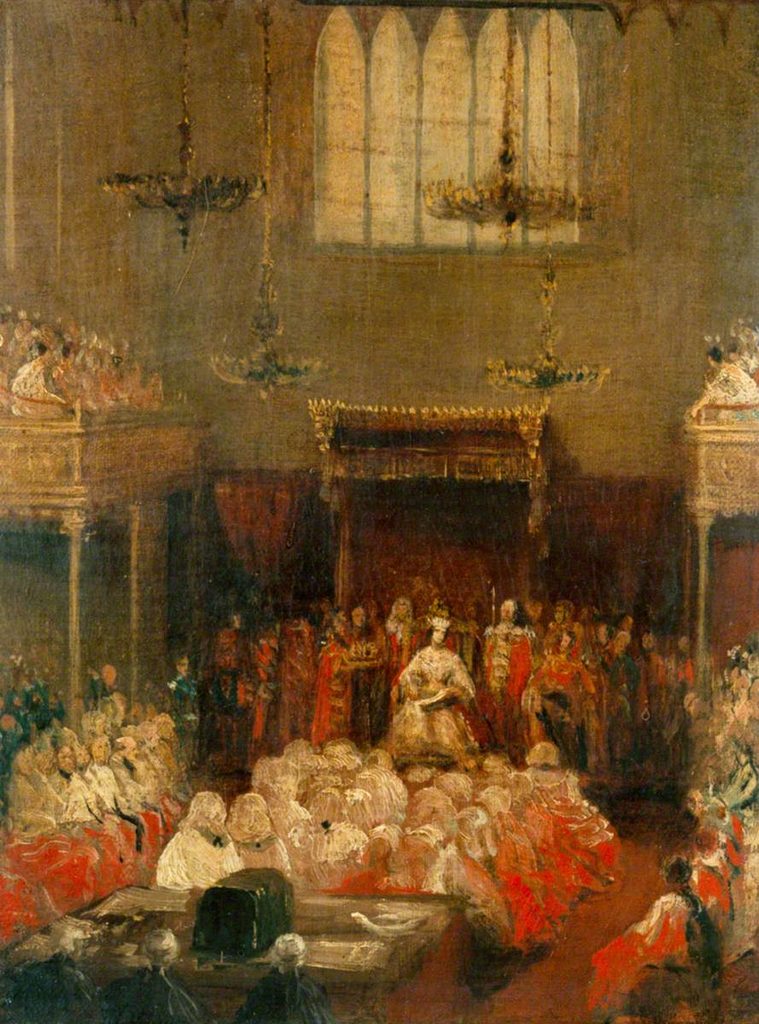
The State Opening of Parliament in the 19th century retained many of the traditions that had developed since the medieval period. But crucially, it was during this period that the ceremony began to look more similar to the event that we see now.
Unlike today, in the 19th century the State Opening did not always take place on the first day of the parliamentary session. The first new Parliament of William IV’s reign in October 1830 also took place without the Monarch present. It was opened ‘by commission’, where the Lords commissioners were sent to open it on his behalf, but he attended a few days later to read the King’s speech, which also happened in 1833 and 1835. Although William IV had appeared on the first day of the session to read his speech in 1831, 1834 and 1836, in 1837 he did not appear at all and the Lord Chancellor read the King’s speech.
In 1834 a fire broke out in the area underneath the House of Lords, destroying most of the old Palace of Westminster. During the late 1830s and 1840s, MPs and peers were housed in temporary accommodation, and this was therefore where the ceremony took place. It was in temporary accommodation that Queen Victoria’s first State Opening took place in November 1837. The opportunity to see the new Queen proved extremely popular; one MP even dislocated his shoulder in the rush and bustle to get the best spot to hear the Monarch’s speech. As Victoria had not yet been crowned, she wore a diamond coronet, with the crown instead carried beside her on a cushion, a custom which was followed for subsequent uncrowned monarchs at the opening of Parliament.
After she married Prince Albert in 1840 there was some debate about what role he should play in these events. Copying what had been done in Queen Anne’s reign, he rode in the carriage with Victoria to Westminster. He had his own chair of state alongside the Queen’s throne in the House of Lords. From 1842 a seat was also provided for their infant son, the Prince of Wales.
In February 1852 Queen Victoria used the full processional route designed by Charles Barry in the new Palace of Westminster for the first time. She came in through a covered entrance under the Victoria Tower (named in her honour) and went up the Royal Staircase to the Norman Porch. She went on to the Robing Room and then processed through the Victoria Gallery (now called the Royal Gallery) to the Lords.
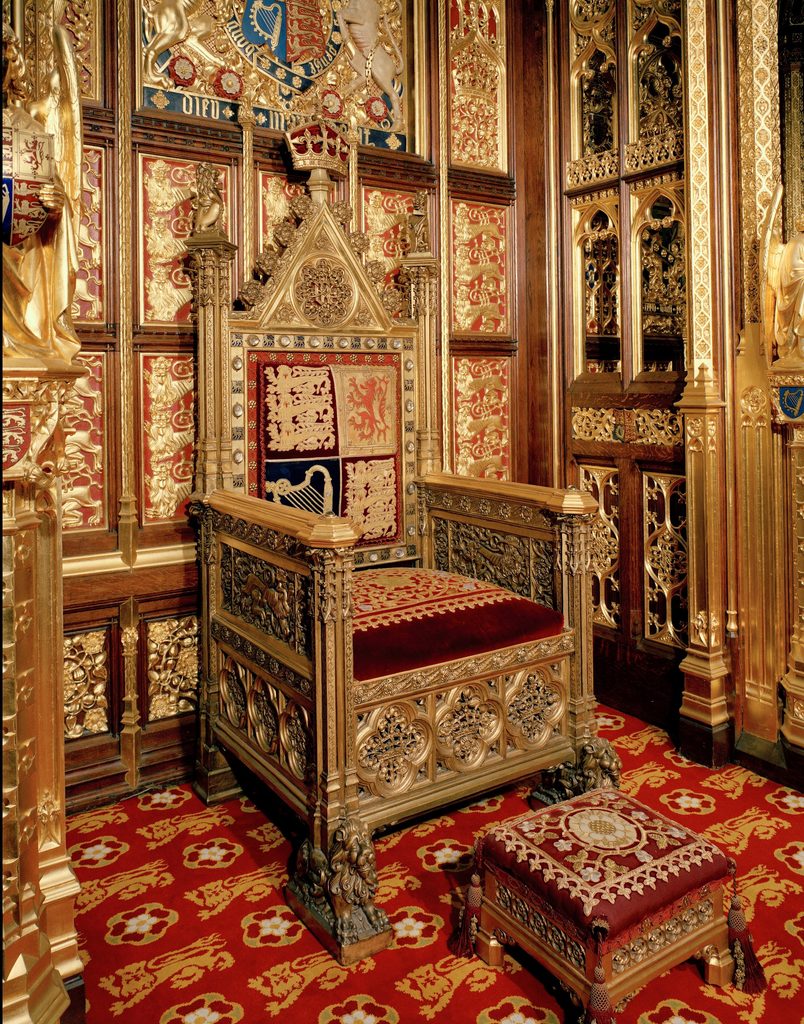
This is the processional route that monarchs still follow today. Victoria had already taken part in a ceremony in the new House of Lords before this, when she prorogued Parliament in 1847, sitting on the throne designed by Augustus Pugin which was a focal feature of the new Lords chamber.
Albert’s death in December 1861 prompted a major shift in Victoria’s relationship with Parliament. She did not attend any events in Parliament for the next four years. She explained that she had always been ‘terribly nervous’ about these ceremonies, but at least she previously had Albert by her side.
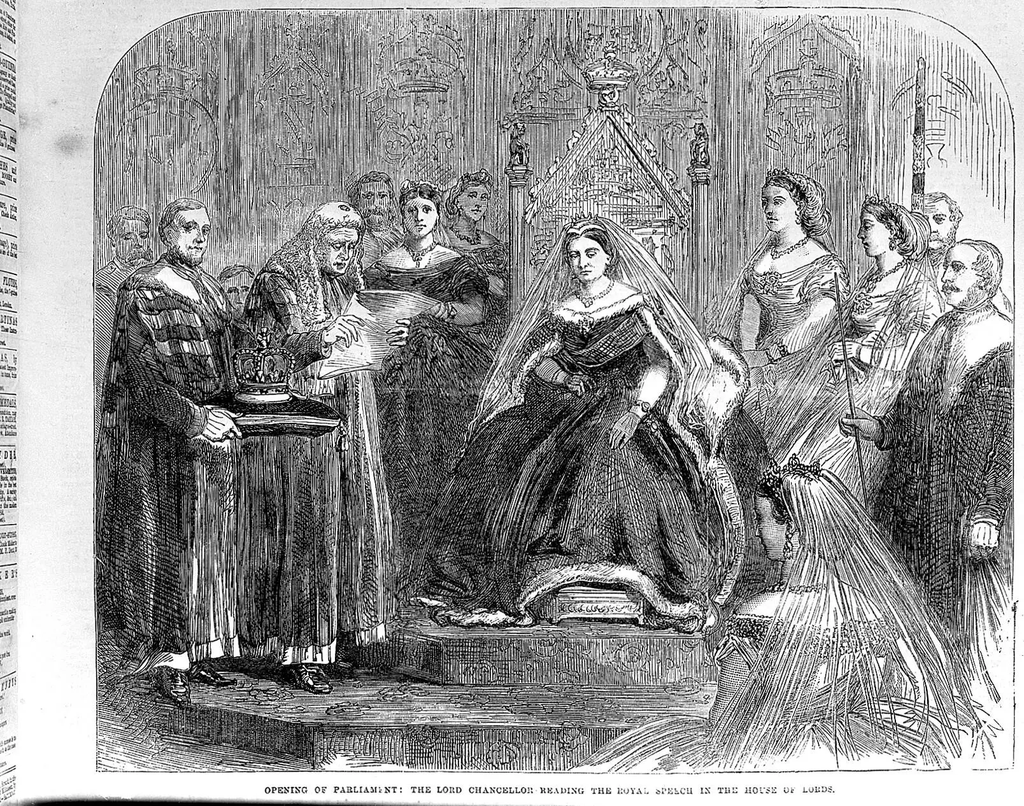
In 1866 Parliament was due to approve a grant of £30,000 for the Queen’s daughter Princess Helena upon her marriage. This prompted the Queen to open Parliament in person again for the first time. In contrast with the glittering diamonds and colourful robes she wore at Westminster at the start of her reign, she now dressed in black with a widow’s cap and a long veil. She did not read the Queen’s speech herself as she had done before. Instead the Lord Chancellor read it on her behalf. After this, the Queen only opened Parliament in person six more times.
Since 1901 there have only been seven occasions when the Monarch has not personally opened Parliament. After he came to the throne in 1901 Edward VII made the State Opening a colourful ceremonial event again. His wife Alexandra did not use the chair of state provided for Prince Albert. Instead she had her own slightly smaller throne.
Find out more on the State Opening in the Victorian period:
Queen Victoria and parliamentary ceremony
Four prorogations and a conflagration: Parliament and its buildings in 1834
Political Prorogations: a view from the Victorian Commons
Queen Victoria at the opening of Parliament, 1866, with the Lord Chancellor reading the royal speech; The Illustrated London News; Wellcome Collection
Post-War Period
Since the Second World War the State Opening has continued to be an important part of the pomp and ceremony of Parliament.
Sir Anthony Grant
Conservative, 1964-1997

© National Portrait Gallery, London, CC BY-NC-ND 3.0
Sir Anthony Grant by Jemima Warren, C1503/0002 [2, 00:50:38-00:50:57]
My dear secretary [said] I got this [office] for you because on the State Opening of Parliament you’ll have the best view of anybody. So I used to ask them all up to have a glass of champagne with me, to see the state coach going past, the trumpeters and the band. It was a marvellous room.
Sir Anthony Grant, interviewed by Jemima Warren, HPT Oral History Project C1503-002 [2, 00:50:35-00:51:05]
The tradition of the Commons actively asserting its independence from the other parts of Parliament also remains a key part of the ceremony. The Labour MP Dennis Skinner (Bolsover, 1970-2019) became famous for heckling Black Rod as they entered the Commons to summon MPs to hear the Monarch’s speech. He was not alone in feeling some scepticism:
Malcolm Savidge
Labour, 1997-2005
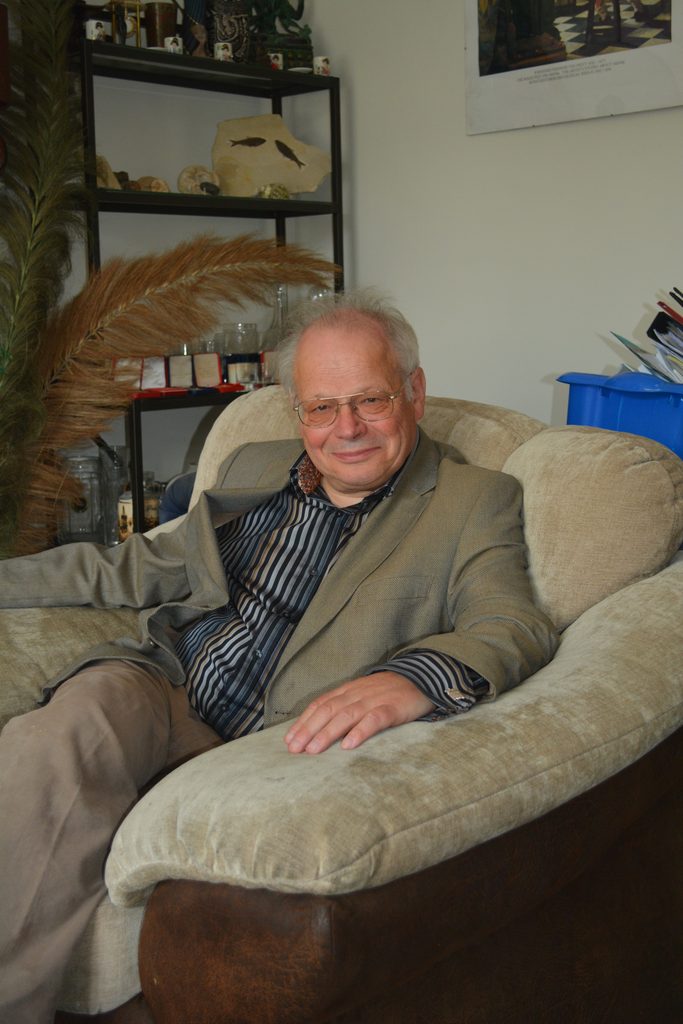
© History of Parliament Trust
Malcolm Savidge by Anne Gulland, C1503/0074 [2, 00:36:42-00:37:40]
I remember being very, very irritated when the BBC got in touch with me about the opening of parliament, and wanted to talk all about the ceremonial of it. I was frankly full of the fact that we’d just announced our programme for the coming year. I just thought: “Hang on, that is just so pathetically trivial”. All this stuff about the fancy show, rather than the serious policies we were trying to put forward. […] I didn’t get myself on their list of their approved people, for the first few weeks in any case.
Michael Savidge, interviewed by Anne Gulland, HPT OHP C1503-74 [2, 00:36:40-00:42:40]
Following the opening of the new Commons chamber in 1951 – after it was bombed during the Blitz – a few, relatively minor, changes to the ceremony and the traditions around it have taken place. The State Opening, including the Monarch’s speech, has been televised since 1958: a considerable time before Commons debates were broadcast. The tradition of the Vice-Chamberlain of the Household – an MP and a government whip – remaining in Buckingham Palace during the ceremony dates back to the 19th century; however, in the 1970s it became commonplace to assume they were being ‘held hostage’ to ensure the Monarch’s safe return. As members of the royal household, government whips have an important role in the ceremony, as Anne Milton (Conservative MP for Guildford, 2005-2019) told our Oral History project:
Anne Milton
Conservative, 2005-2019
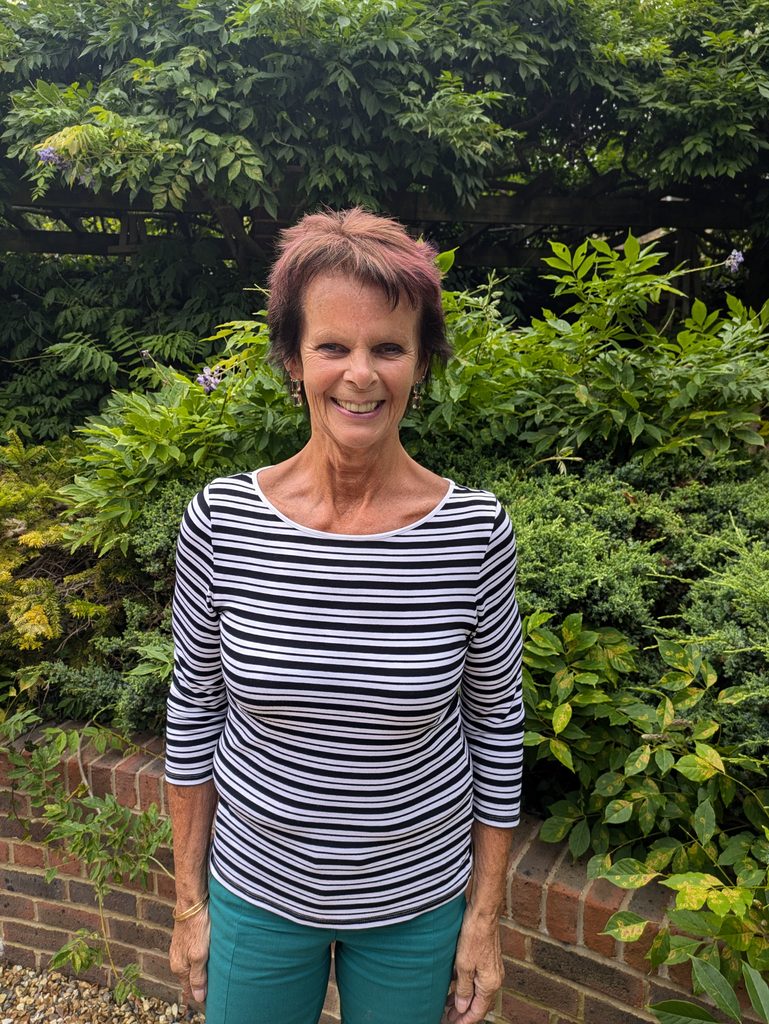
© History of Parliament Trust
Anne Milton by Emmeline Ledgerwood, C1503/0248 [6, 01:05:25-01:06:13]
On the day of the Queen’s Speech […] the Vice-Chamberlain is taken hostage in Buckingham Palace, to make sure […] Parliament gives the Queen back. I was never there, but when I was Deputy Chief Whip you’re part of the whole event. I went in a carriage with Princess Anne […] It was an open landau and it was fabulous. Everyone was shouting “hello Anne” and I thought, “gosh, they know who I am.” Then it registered they weren’t talking to me! [Laughs] That’s lovely. That is a real privilege.
Anne Milton, interviewed by Emmeline Ledgerwood, HPT OHP C1503-248 [6, 01:05:30-01:06:20]
In 1998, as part of Parliament’s modernisation programme, there were proposals to slim down the State Opening: to shorten the ceremony or even hold it just once after the election (rather than at the start of every parliamentary session). These proposals were widely resisted, and only a few minor changes were made. The processions were simplified, and the Lord Chancellor was allowed to turn his back on the Monarch after having delivered the speech. Since then, the Lord Chancellor has chosen whether to do so and other royal officials – such as the Earl Marshal in 2003 – have also turned their backs.
An additional change was required in 2006 following the creation of the office of Lord Speaker; the new position needed a role in the ceremony. The first Lord Speaker, Helene Hayman, remembered being ‘terrified of tripping up’ and feeling a ‘tremendous responsibility’ being the first Lord Speaker to participate, especially as her role was initially unclear:
Helene Hayman
Labour, 1974-1979
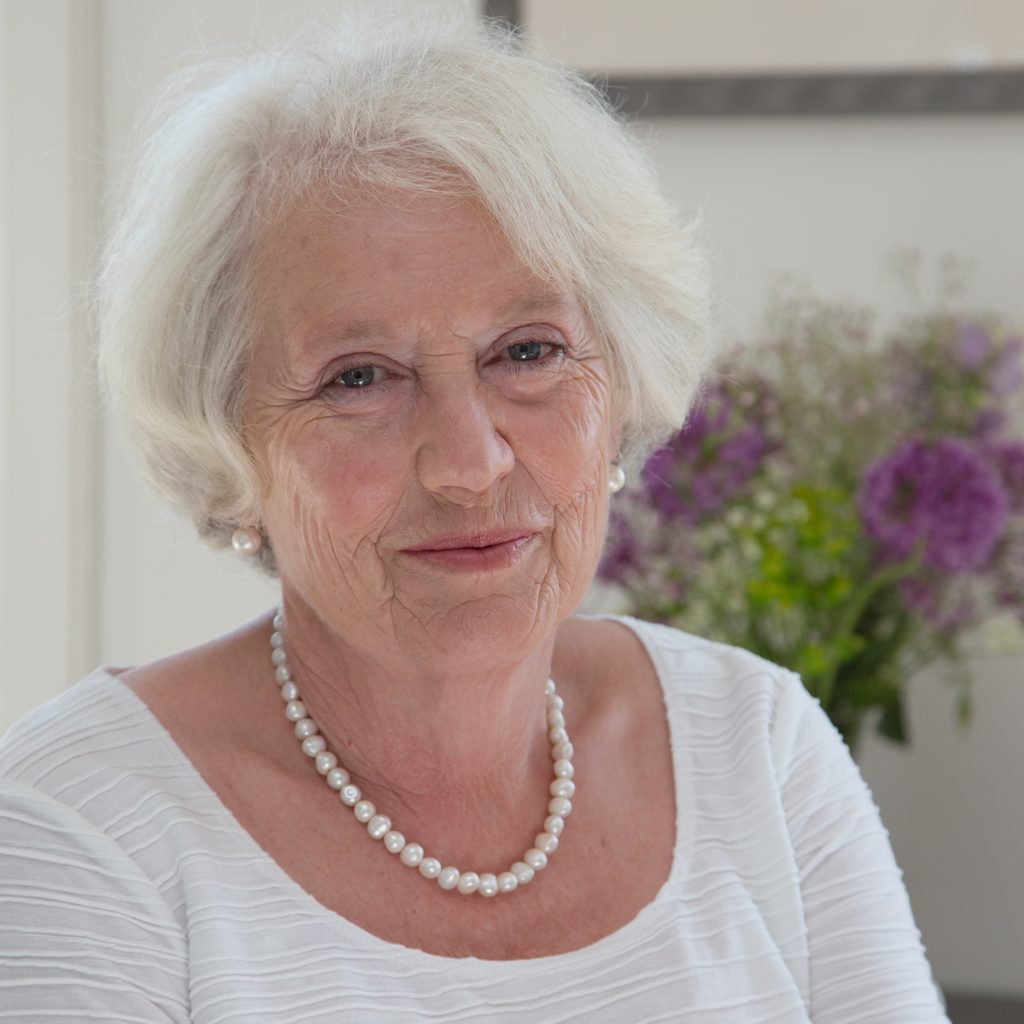
© Barbara Luckhurst / History of Parliament Trust
Helene Hayman by Emmeline Ledgerwood, C1503/0115 [8, 00:17:25-00:18:53]
The first state opening they had to decide what my role was, because they’d always had the Lord Chancellor before. So Black Rod and the Palace basically made up a bit of ceremonial the night before. Luckily there were two maces: the Lord Chancellor’s mace and there was a spare, so that became the Lord Speaker’s mace. So it was decided that I would process separately, I would go down with the Leader of the House of Commons and we’d go down to meet the Queen together […] But this was made up on the back of an envelope the night before. And after State Opening I watched the coverage, it was Nicholas Witchell or someone. And he was saying “And now we see the Lord Speaker processing with the mace in front of her, behind carrying the train, she will go down and meet the Leader of the House of Commons, and they will go down…” And you would have thought it had been going on for 500 years, you know. It’s a wonderful country [laughs] for that sort of sleight of hand.
Helene Hayman, Baroness Hayman, interviewed by Emmeline Ledgerwood, HPT OHP, C1503/115 [8, 00:17:25-00:20:10]
For a deeper explanation of the State Opening’s history, read this briefing from the House of Commons Library.