
Hansard is the official record of what is said in Parliament, including in the House of Commons, in the House of Lords and in Committees, originating in the early 19th century.
You can access Hansard and the official account of Parliament here.
While modern Parliament produces a detailed, edited account of every debate in Westminster’s chambers and committee rooms, reporting methods have changed drastically over time. Recording what politicians said was not always an official duty, nor was it always permitted by law…

Early Recording of Parliament
The Official Record
The first formal record of Parliament dates back to the medieval period, in the form of Parliament Rolls. These were compiled by the Clerk of the Parliaments at the end of each assembly and recorded the general proceedings of Parliament, including the record of public acts passed, as well as a small number of private ones. These rolls date from 1275-1504, and can be accessed via The National Archives.
As these rolls recorded mainly the public acts passed, early records do not contain much information about the daily goings-on in Parliament. Therefore, clerks like John Faukes, Clerk of the Parliaments 1447-70, began to keep private journals of the proceedings. These private journals would become an unofficial record of Parliament.
The first complete Journal of the House of Lords began in 1510, whilst the earliest complete Journal of the House of Commons began in 1547. In a development from the earlier rolls, both journals recorded the names of those appointed to committees, messages sent and received, and the passage of bills. However, during this period the Lords was far smaller than the Commons, so only the Lords Journal recorded daily attendance.
Did you know?
One of the printers who produced the Journals of the House of Commons was Luke Hansard, who published the records from 1774-1828.
But it was his son Thomas who would go on to establish the eponymous daily report in the 19th century – creating the famous publication still used today…
The Parliament Rolls still continued to be a formal record of the bills enacted by Parliament and special Parliament Rolls were sometimes created to record important judgments. For example, in 1586 a special Parliament Roll was created to record the proceedings against Mary, Queen of Scots.
The Journals of the Lords and Commons remained the primary record of both Houses over the following centuries, with the clerks continuing to be important figures in both how Parliament was recorded and how the Houses functioned. Examples of this include Henry Elsynge and Henry Scobell, Clerks of the Commons during the Civil War period (1640-1660), who were influential in not just the official record-taking but also deciding questions of procedure (rules of the House).
However, both of these sets of journals were missing important information. Firstly, even as late as the early 19th century, the Commons Journal still did not have a record of attendance, but noted instead the overall numbers voting in divisions and the names of tellers. But more significantly, neither set of journals recorded the words spoken in debate. Both Houses expected to be able to debate freely, and it was thought that an official record of what was said might curb free speech. In fact, by the 18th century it was deemed a breach of parliamentary privilege to report debates in either House of Parliament.
So, in order to plug some of the holes in information left by the Journals and Parliament Rolls, historians have turned to unofficial records to find out what was happening in Parliament.
The Unofficial Record
In the medieval period, before abbots were removed from the House of Lords in the 16th century, chronicles kept by monks contained private accounts of the proceedings of Parliaments. Famous examples are the writings of Thomas Walsingham and John Benet’s chronicle.
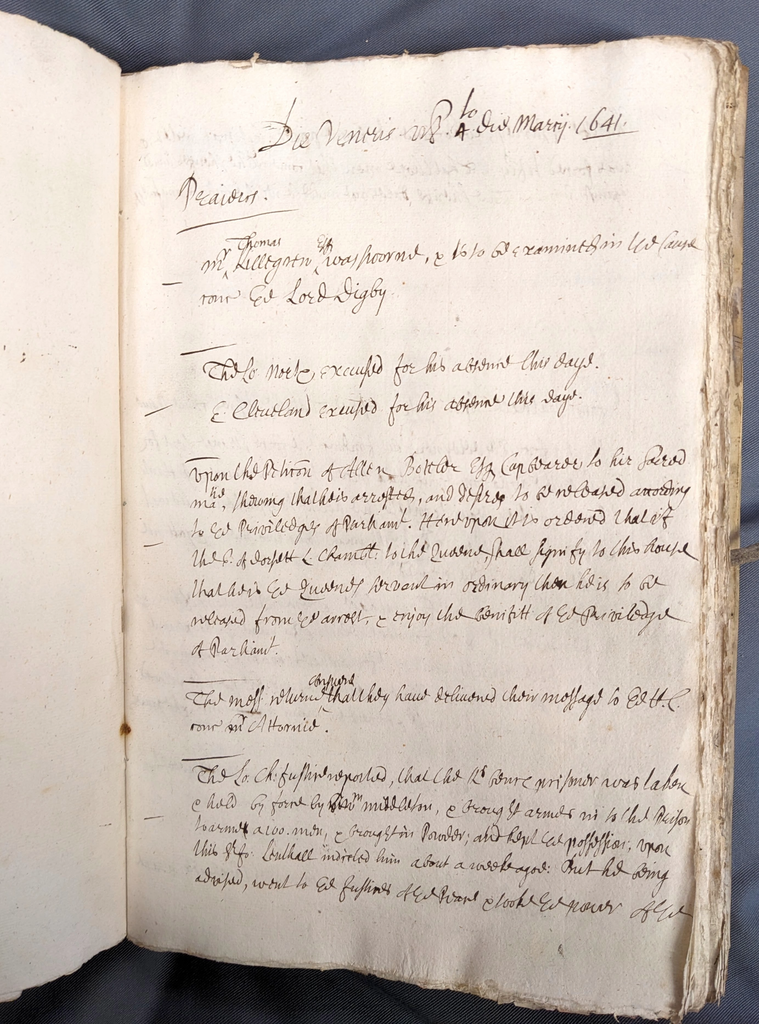
Did you know, we named our weekly newsletter after these scribbled books?
Click here to read the latest posts on our Substack.
Records surviving from the early 17th century also show that semi-official records were kept by clerks in what was known as a ‘scribbled book’. The earliest surviving Lords scribbled book is from 1610, and from 1604 the Clerk of the Commons Ralph Ewans kept a scribbled book. But, as these books were the private property of each clerk, their survival was not guaranteed.
A more unofficial record came from personal diaries or journals of proceedings kept by individual members of either House. As these were the private property of the author, not all survive today. The earliest journals kept by members of the Commons date to 1571 and the earliest Lords diary to 1610.
Unofficial records began to be used to write works on parliamentary procedure. The 16th century MP John Hooker used his personal diary to later write The Order and Usage of the Keeping of a Parliament in England, a piece of writing intended to provide an example for the Irish Parliament, which was deemed to be unruly.
These private accounts were usually far more detailed than the official record kept in the Commons and Lords Journals. However, they were also sometimes more selective, as the writer could ignore matters that did not interest them, or could only record proceedings when they were present in the chamber. The motives for writing diaries also differed widely. Some new MPs kept diaries of events in the Commons for personal instruction, whilst others may have kept them to inform their constituents and friends more accurately of what was said and done at Westminster.
Sir Simonds D’Ewes, MP for Sudbury in Suffolk, compiled a very detailed diary between 1640 and 1645. His counterpart in the later 1650s was Thomas Burton, who sat for Westmorland in 1656 and 1659. There were few diarists in the Lords, although the bishop of Rochester, John Warner, kept a diary in the Upper Chamber for a short period before the outbreak of civil war in 1642. Technically members were not permitted to make notes of speeches, but men like D’Ewes and Burton were tolerated by the Commons. They developed a close connection with the House authorities and were even allowed to consult the draft Journals.
Some Commons diaries or private journals were copied for external circulation and can be found in archives across the country. This suggests that these diaries were consulted by others to discover what was said and done in Parliament.
Find out more about parliamentary diarists during the Civil Wars here.
Early Reporting of Parliament
Despite lacking modern means of communication or news distribution, a wide interest in Parliament’s proceedings among the public can be seen as far back as the medieval period.
Although there are limited sources from the time, evidence shows an apparent enthusiasm for parliamentary reporting. Dated 1485, there is an extensive written record by the MPs for Colchester, as well as verbal reports made to the town corporation by the MPs for Bishop’s Lynn. In the limited private correspondence that survives from the period there are also occasional accounts of the business of Parliament.
During the 1590s, more detailed accounts of events in Parliament began to appear. Newsletters, which preceded the circulation of newspapers from the 1640s, may have enjoyed a wider circulation as they were often shared by their gentry recipients with friends and relatives. By the 1620s men of political substance who were unable to sit in Parliament themselves often received political and parliamentary news from particular correspondents.
Occasionally individual speeches given in Parliament survive as ‘separates’: copies of speeches prepared for circulation. For example, a number of speeches given by members of the House of Lords opposed to the restoration of Protestantism in 1559 survive. These were produced to try to influence public opinion and create popular resistance to the measure.
During the Civil Wars, Parliament was keen to control how much information about its proceedings reached the general public, but plenty of letters survive showing that MPs nonetheless kept their constituents informed of developments at Westminster.
One challenge for Parliament in controlling this information was the explosion of printed pamphlets and newsbooks. Although the text of acts which had been passed was routinely published by official printers, reporting of other business (especially speeches) was tightly controlled. This did not stop speeches from making their way into print, with or without the permission of the MP concerned.
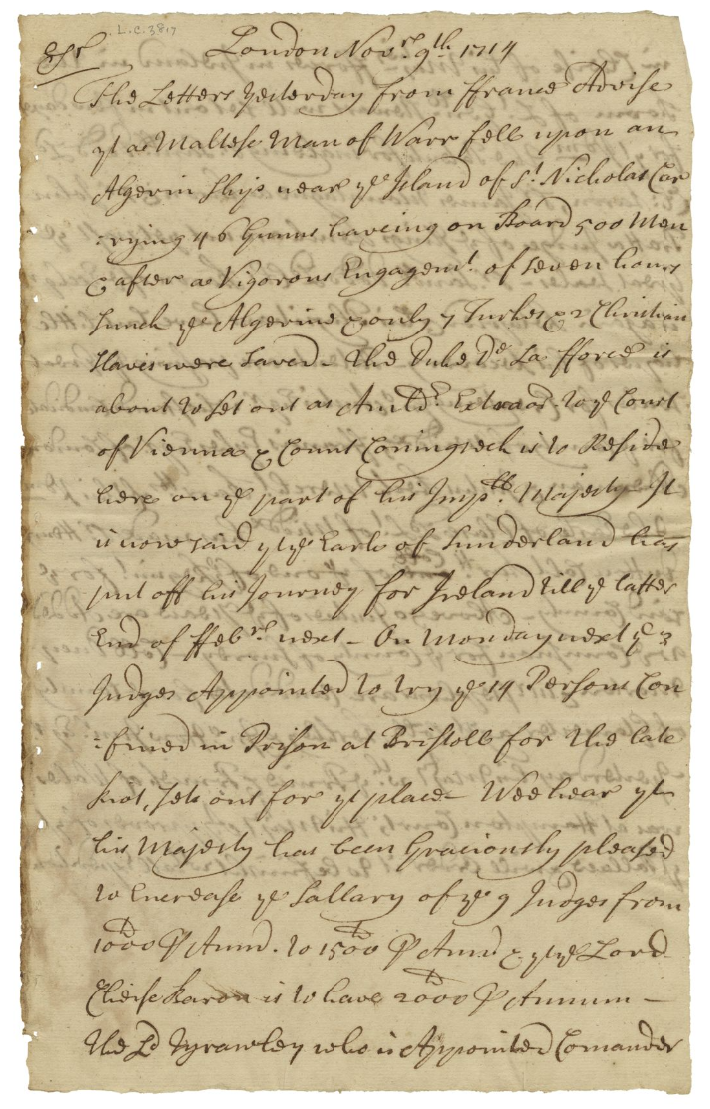
The Commons also became very good at using the press to get its own message across during the Civil Wars. Printed propaganda became an important part of politics, with Parliament and the King being supported by rival publications. Restrictions were tighter during the 1650s, however, and the public had to rely on government newsbooks, such as Mercurius Politicus, for information on what was happening in the House of Commons.
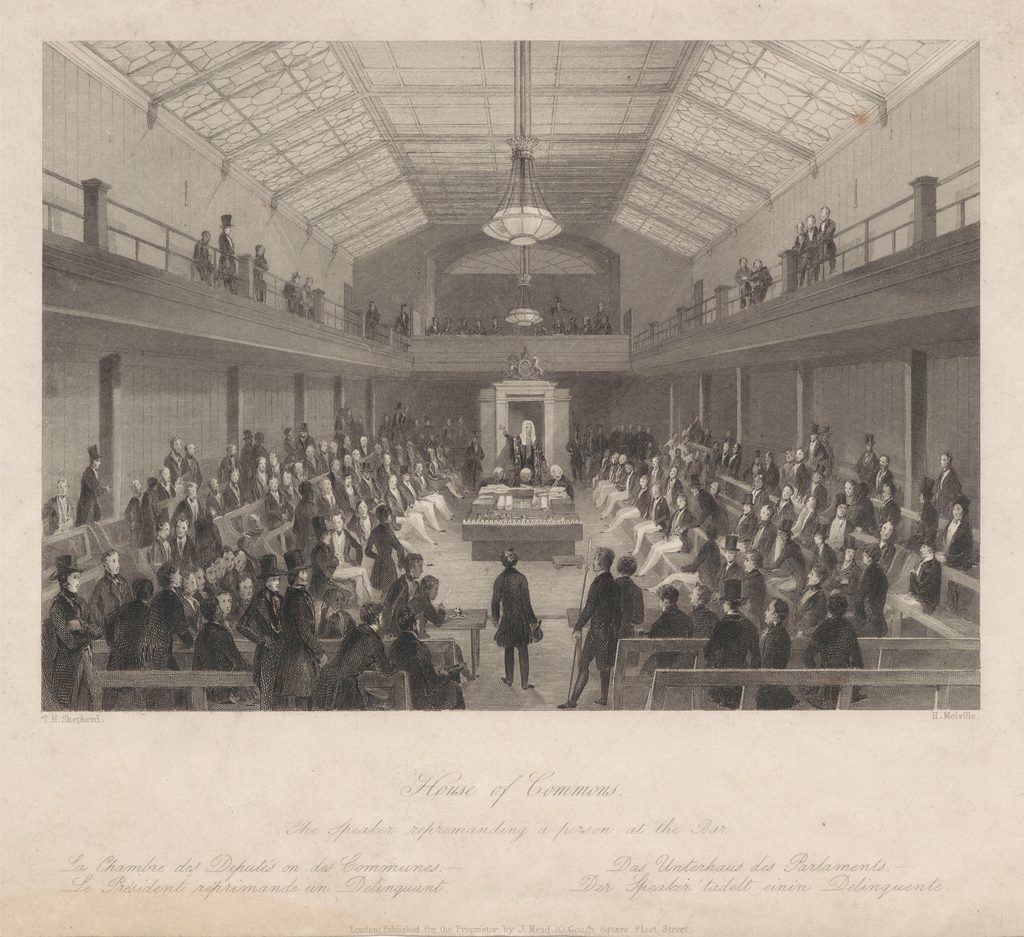
Later, during the Georgian period, although it was technically illegal, some publishers did attempt to produce records of speeches in Parliament. For the Lords, one of the earliest versions was by Ebenezer Timberland, but this ceased after the early 1740s. Other early reporters of Parliament included people like the printer, Abel Boyer. On occasion Parliament made a point about insisting on its privileges and printers were summoned to the bar of the House to be reprimanded. Sometimes they were imprisoned and fined.
In 1771 several printers were encouraged by the radical MP John Wilkes and other prominent politicians in the City of London to print debates in their newspapers. This triggered a crisis which resulted in the Commons ultimately giving way.
Thereafter, serious efforts were not made to restrain reporting of debates from the Commons. The Lords resisted for a few more years, but then also gave up the struggle.
From the early nineteenth century a fairly full set of reports of major speeches was being produced by the journalist (and future MP) William Cobbett. It was his business that was ultimately taken over by Thomas Curson Hansard.

William Cobbett
1763-1835
A prominent and vocal journalist, Cobbett produced a weekly newspaper, The Political Register and Cobbett’s Parliamentary Debates.
In 1810, Cobbett was jailed and fined for seditious libel. Faced with financial difficulties after his release in 1812, he sold Cobbett’s Parliamentary debates to Thomas Curson Hansard.
After numerous attempts at running for Parliament, he was finally elected as an MP for Oldham in 1832 and served until his death in 1835.
William Cobbett, possibly George Cooke (c.1831), © National Portrait Gallery, London, CC BY-NC-ND 3.0
The Emergence of Hansard
The public had always desired to hear what business was taking place at Westminster, and as rules on what could be recorded and shared began to be loosened towards the end of the 18th century, the potential value of an ‘official’ report became apparent.
In this period, the Commons clerks noted the key events of each day in a record known as the Votes and Proceedings. These included the results of divisions (votes), the appointment of committees and the passing of legislation. These daily reports were then compiled into the Commons Journal. The House of Lords had its own Lords Journal. But the Commons Journal and the Lords Journal did not record what MPs and peers said during debates.
Newspaper reports filled this gap, and parliamentary reporting expanded significantly from the late 18th century.
In the early 19th century House of Commons newspaper reporters usually sat in the back row of the strangers’ gallery and had to compete with members of the public for seats. In May 1803 the reporters were unable to get spaces in the gallery to report on a major speech by William Pitt. After this, the Speaker arranged for the reporters to be allowed into their seats ahead of the public. One of the most famous parliamentary reporters in this period was Charles Dickens. He wrote for newspapers and another publication called the Mirror of Parliament. He used these experiences within some of his novels.
In October 1834 a major fire destroyed much of the old Palace of Westminster. MPs moved into a temporary chamber, using what had been the House of Lords, which gave the reporters their own gallery for the first time. These improved facilities highlighted the importance of the press. Therefore, the new Palace of Westminster that was built after the fire included a separate reporters’ gallery in the House of Commons, used from 1852. The reporters’ gallery was enlarged in 1881 to provide more seats for members of the press.

© National Portrait Gallery, London, CC BY-NC-ND 3.0

Thomas Curson Hansard
1776-1833
Thomas Curson Hansard used reports from the press to compile Hansard Parliamentary Debates. He started this publication in 1812, when he bought Cobbett’s Parliamentary Debates, which had been produced by the radical journalist William Cobbett since 1803.
Hansard did not employ his own reporters, but instead used several different newspapers to put together his reports. This meant that Hansard, as it became known, gave a fuller record of debates than any one publication. It was not, however, a verbatim record. Hansard did not include every word spoken in the Commons chamber.
Thomas Curson Hansard (1776-1833): frontispiece, T. Hansard, Typographia: an historical sketch of the origin and progress of the art of printing (1825)
MPs discussed having an official report of debates several times during the 19th century. A key argument against this was that no one would want to read a verbatim record of everything said in the Commons, so an official report would be an unnecessary expense.
However, the style of reporting in the press was changing. Summaries of debates were becoming more popular. So were ‘sketches’ focusing on the atmosphere in the chamber and the personalities involved. At the same time, the Commons was getting busier and sitting for longer each day. Some debates received less attention from the reporters, such as debates after midnight. This made it more difficult for Hansard to put together its reports.
From 1855 Hansard, now published by the original Hansard’s son, received some financial support. The government agreed to buy 100 copies (which soon increased to 120) each year for official use. From 1878 Hansard received an annual subsidy of £3,000 (later increased). In return, it had to fill in the gaps in press reporting, such as reporting on bills in committee. This meant that Hansard had to employ his own reporters for the first time.
In 1889 the Hansard family ended its connection with the publication and following a series of issues with subsequent publishers, the Commons eventually made the decision to produce its own official report in 1909. Despite attempts to establish a new title for the record, the old family name stuck in the minds of the public and Parliament, and from 1943 Parliament’s reports officially adopted the title ‘Hansard’.
Hansard and the Commons Journal were not the only records of the work of the Commons. In 1836 the Commons began publishing official records of divisions (votes). These listed the name of every MP voting for or against a motion. Before this, only the total number of MPs and the names of the tellers on each side had been officially recorded. The press had given unofficial lists, which were not always accurate. Parliament also authorised the printing of reports of select committees and royal commissions. These parliamentary papers were often known as ‘Blue Books’ because of the colour of their covers. They also included information gathered at the request of the Commons.
Modern Reporting
In the modern era all major newspapers drastically reduced their coverage of debates in the Commons chamber, in favour of ‘lobby’ stories giving a behind-the-scenes look at everyday life on the parliamentary estate. Yet, with the expansion in broadcasting and radio and television coverage, Parliament is currently the most open it has ever been.
Following the destruction of the Commons chamber during the Blitz, the rebuilt chamber (opened in 1950) included increased provisions for the press: 95 seats for reporters were added, as well as better telephone facilities, and microphones from the chamber were connected to the press gallery. However, the 1949 Beveridge enquiry into broadcasting the chamber had concluded that it would be ‘harmful’ to utilise these microphones to broadcast Parliament to the nation.
By the 1960s, pressure began to increase for television and radio broadcasting to take place from the chamber. Those in favour argued that it would increase interest in Parliament and improve understanding of how it worked. Opponents, however, raised two primary concerns: politicians feared news programmes would air short, out of context soundbites rather than full speeches, and many worried that cameras would ruin the style of debate by favouring performative ‘actors’ over reasoned debaters. Despite these fears, broadcast media had become central to political news in the postwar era, and Parliament risked becoming sidelined if it refused to adapt.
In 1964 a select committee recommended a trial of television broadcasting, but the House of Commons rejected it. Radio broadcasting fared better; it was trialled in 1975 and made permanent in 1978. The first parliamentary voice heard on radio in 1975 was MP Tony Benn, whose opening speech was warmly received by the press. Yet, televising the Commons remained fiercely contested, requiring 11 separate debates over 22 years before a TV trial was finally approved in 1988.
The House of Lords actually led the way in television broadcasting. On 23 January 1985 the Upper House televised its first session, featuring a famous speech by former Prime Minister Harold Macmillan (then Earl of Stockton) criticising the Thatcher administration.
The House of Commons followed suit with its first televised debate in 1989, following a long process of negotiation over rules and standards. Technicians had to install remote-controlled cameras and enhanced lighting within the chamber to provide good quality images. Regulations dictated that shots were largely restricted to the head and shoulders of the MP speaking, strictly banning wide shots or ‘reaction’ shots of listening politicians. MP Ian Gow’s response to the Queen’s Speech was the first debate to be televised, on 21 November 1989. This was an ironic moment, as Gow had opposed broadcasting the chamber and joked about his appearance.
The Commons made TV coverage permanent in 1990. As digital media evolved, Parliament launched its official website in 1998 and began live-streaming debates in 2002. Dedicated political reporting expanded further in 1998 with the launch of BBC Parliament, ensuring continuous coverage across both chambers and committee rooms.
The effect of the introduction of broadcasting from the chambers was a move away from press reporting of debates themselves and a focus instead on the primacy of the ‘lobby’: journalists who report on stories around Parliament rather than on debates in the chamber.
Crucially, while methods of presenting events from Parliament have shifted throughout the centuries, the public desire to find out what is going on at Westminster has always persisted.
Kenneth Baker
Conservative, 1968-1970; 1970-1997
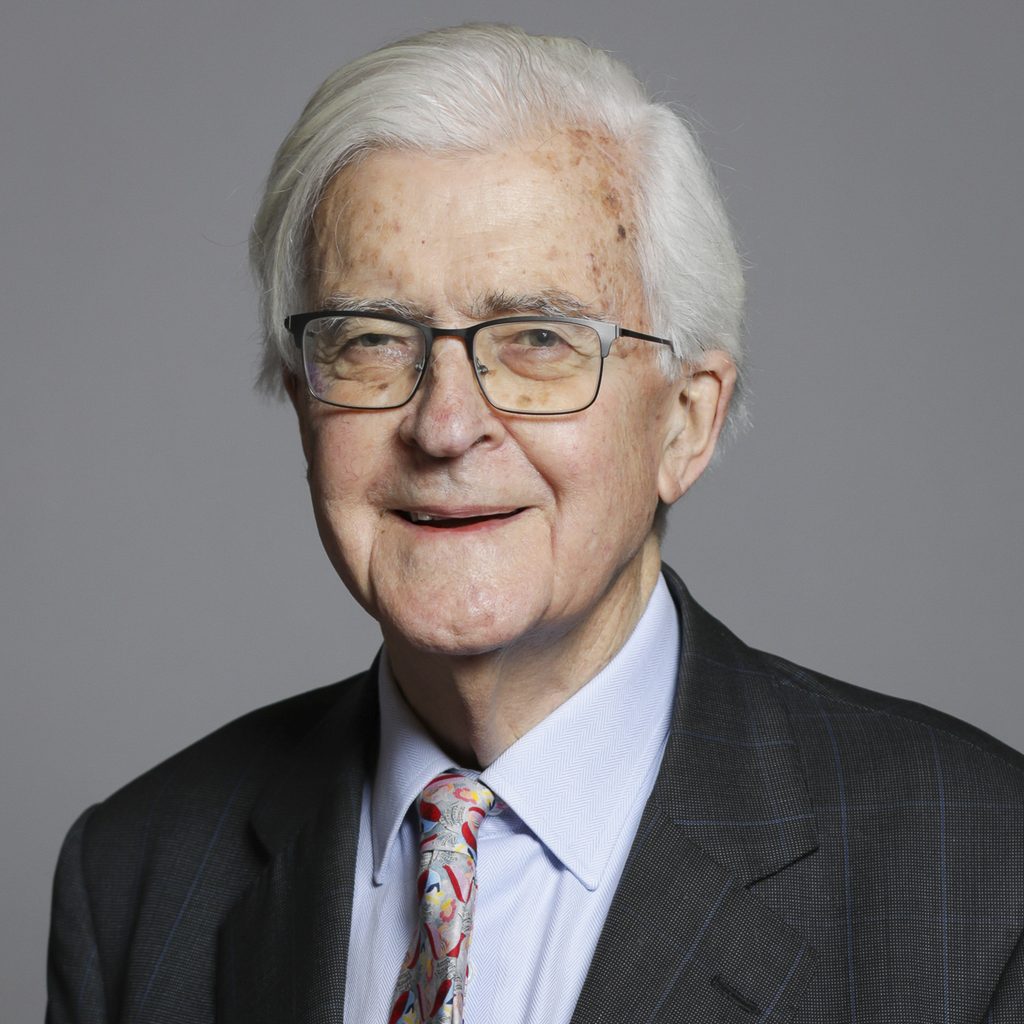
Kenneth Baker by Mike Greenwood, C1503/0013, [1, 00:52:56-00:53:56]
Joan Ruddock
Labour, 1987-2015
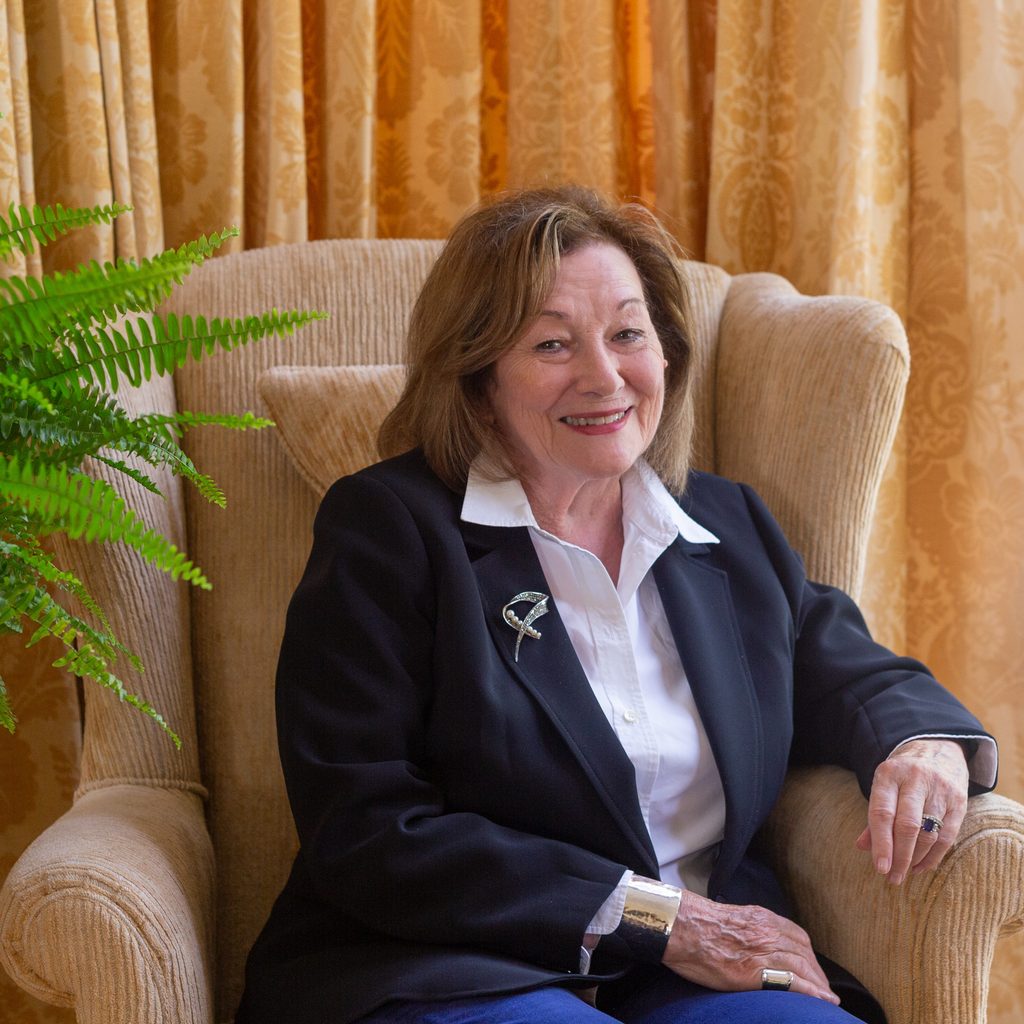
Joan Ruddock by Debra Davison-Smith, C1503/0239, [6, 00:28:20–00:31:50]
Marion Roe
Conservative, 1983-2005

Marion Roe by Eleanor O’Keefe, C1503/0071, [1, 02:58:38–02:59:32]