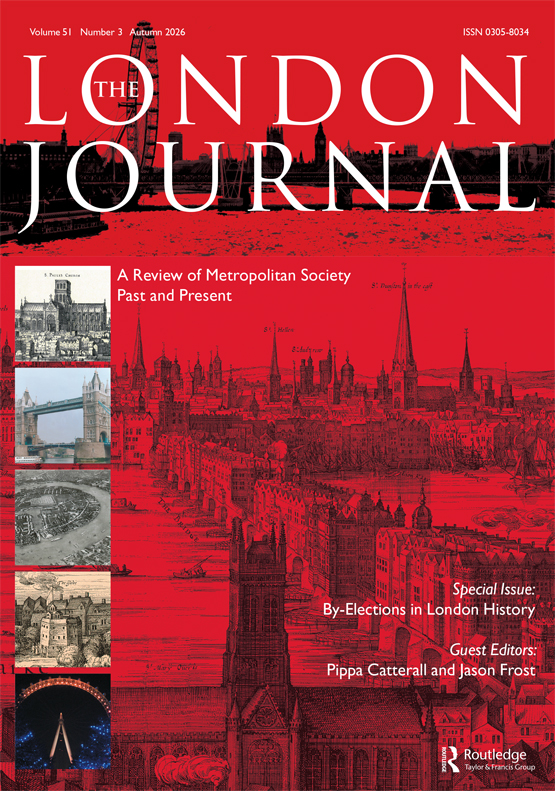

At the IHR Parliaments, Politics and People seminar on Tuesday 17 November, we will be hosting a hybrid launch event in-person and via Zoom with the contributors of a special edition of the London Journal on ‘By-elections in London History‘.
The event takes place on 17 November 2026, between 5:30 and 6:30 p.m. It is fully ‘hybrid’, which means you can attend either in-person in London at the IHR, or online via Zoom. Details of how to join the discussion are available here.
Ask a prime minister about a by-election defeat and you will usually get a shrug. ‘It’s mid-term, it’s a protest,’ as David Cameron put it in 2013. Ask the media and you get the opposite reaction entirely: over 9,000 articles were published about the 2021 Hartlepool contest alone. Somewhere between the ministerial dismissal and the media circus lies a more interesting truth, and it is one that scholarship has been slow to pursue.
By-elections have too often been treated as little more than thermometers for government popularity, when in reality they are events in their own right; moments when a single locality becomes the focus of national attention, and when local and national grievances are aired together for once in primetime.
This political theatre is nothing new. Dickens satirised it in The Pickwick Papers, drawing on his own reporting from campaigns in the early 1830s, while Trollope in Can You Forgive Her (1865) described contests featuring armies of men carrying placards and public houses open on every corner. Churchill claimed that the chorus girls of Daly’s Theatre sat up all night addressing envelopes for his 1924 Westminster Abbey campaign. Children were still being taught election rhymes to sing for or against candidates into the 1920s, and today’s fringe candidates are their direct descendants; less absurd than they appear, and often a rather useful measure of disaffection from mainstream politics.
What has changed is the machinery. Before 1832, by-elections were a regular route into the Commons and were mostly uncontested, not least because of the expense. The range of occasions for by-elections has declined since then. By-elections due to ministerial appointments, bankruptcy or insanity have essentially disappeared. What remains is elevation to the Lords, and – more usually – death, resignation or scandal.
The Recall of MPs Act 2015 added a further route, and in doing so revived the very old idea that an MP answers first to their constituents rather than to their party or the executive. That instinct runs deep, and it shows in the data. Government vote share fell by an average of 12% in by-elections between 1979 and 2022, but that average conceals enormous local and circumstantial variation, and only 39.5% of seats that changed hands reverted to their usual allegiance at the following general election. Local candidates do best. Local issues matter.

The consequences are real rather than symbolic. By-elections have changed government policy, settled arguments about the direction of parties – as in the Conservative contests in Westminster in 1924 and 1931 – and acquired near-mythic status in national debate, as East Fulham did in 1933 during the arguments over appeasement and rearmament. They have also ended premierships. Margaret Thatcher later reflected that the restiveness of Tory backbenchers was transformed into open panic by the Eastbourne by-election of October 1990, with further defeats weeks later helping to seal her fate. Andy Burnham’s win in Makerfield brought Keir Starmer’s premiership to an end.
Nowhere is this impact clearer than in London. It is not simply that contests in the capital are more readily noticed within the Westminster bubble, though they are. London is itself a variegated political entity with shifting loyalties and a complex political geography, and the neat division between a Conservative Outer London and a Labour Inner London, popularised by the electoral map of the 2008 mayoral contest, has never quite held. Nonetheless, these imagined geographies persist in the imaginations of both the public and historians. As Jerry White observed, ’Bexley is a world away from Brent.’
Meanwhile, the capital’s by-elections have repeatedly functioned as early warning systems on policy issues. The Liberal defeat in Bow and Bromley in 1899 signalled public support for the South African War. Croydon in 1909 was a key moment in the Dreadnought naval race and the constitutional crisis around the People’s Budget. Camberwell North in 1922 led the Lloyd George Coalition to drop some of the more unpalatable aspects of the Geddes Axe. Hammersmith in 1926 showed the electoral impact of the General Strike whilst Richmond Park in 2016 became a proxy for the national argument over Brexit.
London by-elections have also been laboratories for electioneering experimentation. Mitcham in 1923 saw Labour pioneer the mass canvass. Brent East in 2003 saw the Liberal Democrats make innovative use of computer technology. As this suggests, London has also been a proving ground for new electoral tactics. Digital micro-targeting, like mass leafleting before it, was rehearsed in London constituencies before going national.
Defining London for these purposes means treating it as a broad urban, cultural and geographical space rather than applying the strict administrative boundaries of the time; which is why Romford in 1894, then still in Essex, and Bexley in 1946, then only just becoming a suburb, belong squarely in the story.
The wider point is that, despite rich literatures spanning electoral studies, urban history, political sociology and media studies, no study has systematically examined London’s by-elections as a distinct analytical category over an extended timeframe. Most either absorb them into general electoral trends or fixate on the sensational features of isolated high-profile contests, rarely offering insight into voter perceptions or local conditions.
Our special issue of the London Journal ‘By-elections in London History’ makes an alternate, straightforward case. It argues that by-elections are best understood not as episodic noise between general elections, but as recurrent expressions of the politics of place. It does so by exploring nine contests spanning 1861 to 2003, from Marylebone and the City of London through to Brent East. Each article is available to view in open access here.
Pippa Catterall and Jason Frost
The event takes place on 17 November 2026, between 5:30 and 6:30 p.m. It is fully ‘hybrid’, which means you can attend either in-person in London at the IHR, or online via Zoom. Details of how to join the discussion are available here.