
The 1945 General Election marked a huge shift in the national political landscape, but how did it look in the localities? Below, we explore people’s first-hand involvement in the election in the South West. This is an updated version of an article ‘1945 Election’, part of From the Grassroots: An oral history of community politics in Devon, a History of Parliament project based at the Devon Heritage Centre, principally funded by the National Lottery Heritage Fund.

The General Election of July 1945 is one of the pivotal turning points in British political history. The Labour Party not only won its first parliamentary majority, but also introduced a wide-ranging programme of social and economic reform which provided the basis for a political consensus lasting over thirty years. Many believe that the election campaign for a post-war government actually started in 1942, with the publication of the Beveridge Report, which Labour was most associated with in the public eye. The Labour Party seemed to express the ‘new popular radicalism’ of an electorate who wanted a post-war Britain that was more socially and economically equal. Historian Kenneth Morgan argued that ‘Labour alone seemed to understand and project the new mood.’ Below, you can listen to Labour party activist Anita Long discuss how her family’s views were influenced by pre-war economic circumstances.
Historians have been divided, however, to what extent the 1945 election result was a ‘positive’ endorsement of Labour and a triumph of socialism, showing British people radicalised by wartime experiences, or more a negative rejection of Conservatism. It was indeed a shock for many that Churchill, the iconic wartime leader, was rebuffed by the electorate. The high unemployment in the 1930s, when the Conservatives were in power, combined with a feeling of national ‘war weariness’, were possible factors in the party’s losses during the first general election in nearly ten years. Labour were also benefitting from a transferral of the ‘anti-Conservative vote’, from the divided Liberals. It is also argued that during the election campaign itself the Labour Party was better organised on the ground, while Churchill handled things badly; especially when on 4th June he used a radio broadcast to talk of Labour in power requiring ‘some form of Gestapo’.
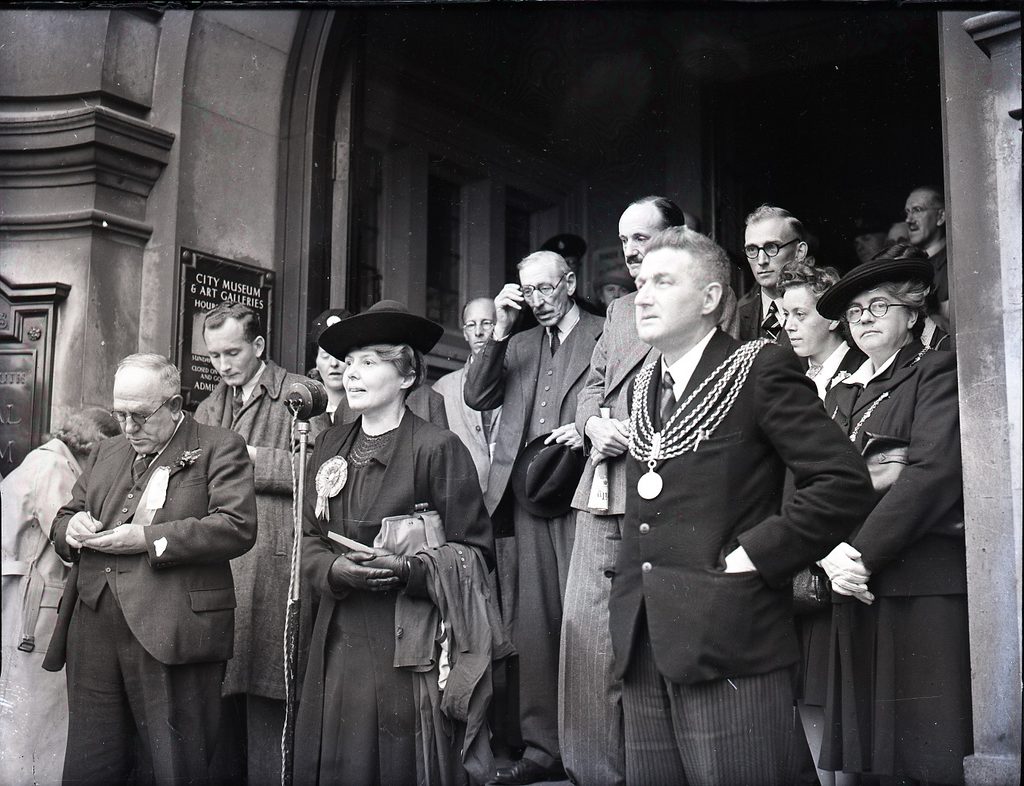
Much less has been written about 1945 in the localities, although election results provide a window into change and continuity in the political map after the general election. The key statistic for the results overall in Devon and Cornwall was the improved performance of Labour in relation to the Liberals. In 1935 the Liberals won 37% of the vote to Labour’s 18%, but in 1945 each party polled 29% of votes cast, compared with 48% for Conservatives (down from 55%). Several of our interviewees remember the 1945 election as one of their first political experiences. Below, you can listen to Labour Councillor Chester Long recount childhood memories of his involvement in the election.
In some respects there wasn’t much modification in the Devon political landscape: the Conservatives continued to hold – as they did in 1935 – the majority of the ten parliamentary constituencies: Exeter, Honiton, Tavistock, Tiverton, Torquay and Totnes. But there was some political change and excitement on the campaign trail in Devon in 1945. In Barnstaple, the incumbent since 1935, Sir Richard Acland, transferred his allegiance from the Liberals to the wartime protest party Common Wealth. When he stood aside in 1945 the Conservatives gained the seat, Brigadier Christopher Peto securing a 4000 majority, with Liberal Mark Bonham Carter in second place.
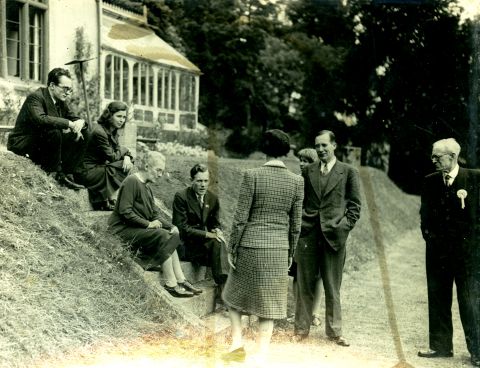
The most significant developments, however, came in Plymouth where all three seats changed hands, echoing the movement towards Labour that produced the landslide victory nationally. In Devonport, Michael Foot defeated the incumbent National Independent, Leslie Hore-Belisha (who had held the seat as Liberal/Liberal National since 1923), securing a 2000 majority in a straight fight. Liberal Councillor David Morrish remembers his parents campaigning for the two rival candidates.
In Sutton, Lucy Middleton for Labour (wife of the party’s General Secretary) captured the seat held for the Tories since 1919 by Lady Astor, who retired. And in Drake, Labour’s Hubert Medland defeated the incumbent Conservative Henry Guest, securing a majority of some 2200 votes. The main newspaper, the Western Evening Herald, reflected many of the key trends of the national campaign and appeared supportive of Labour’s campaign in Plymouth. The focus on new housing, for example, was not surprising given the scale of bomb damage in the city.
Below, David Verney, former Devon County Councillor, remembers the 1945 campaign in North Devon.
Further Reading:
Steven Fielding, ‘What did the people want? The meaning of the 1945 General Election,’ The Historical Journal, Vol. 35, No.3, 1992, pp. 623-639.
Kenneth Morgan, Labour in Power. 1945-51, Oxford, 1984.
Kevin Jefferys, ‘The 1945 General Election in Devon’ (lecture at Devon Heritage Centre, 20 Jan 2014)
