
Despite the national pattern that established itself after the 1945 General Election, the South West remained a strong hub of the Liberal Party. You can find out more about Liberalism in Devon from those involved below. This is an updated version of an article ‘Liberalism in North Devon’, part of From the Grassroots: An oral history of community politics in Devon, a History of Parliament project based at the Devon Heritage Centre, principally funded by the National Lottery Heritage Fund.

Labour’s landslide victory in the 1945 General Election swept away much of the remnants of the pre-war Liberal Party. Henceforth, British politics was set for the rest of the twentieth century to be a two party system between the Conservatives and Labour. Yet the overall pattern since 1945 obscures regional variations. Far South-West Britain is one of the regional peripheries that could be viewed as bedrock for the Liberal Party. In many rural parts of the region the continued influence of religious nonconformity coupled with the dominance of independent industries such as farming and fishing, sustained traditional political allegiances which had existed for generations. Below, Liberal Councillor Joan Morrish discusses her family’s long support of Liberalism, partly due to the party’s links with Methodism.
Nonetheless, even in its heartlands, the Liberals’ influence had been in decline from the interwar period, and it wasn’t until the 1950s that the Party’s fortunes took a turn for the better. Cornwall and Devon were linchpins in this revival of the Liberals, and by the end of the decade they were once more the second party in the region in terms of the overall share of the vote.
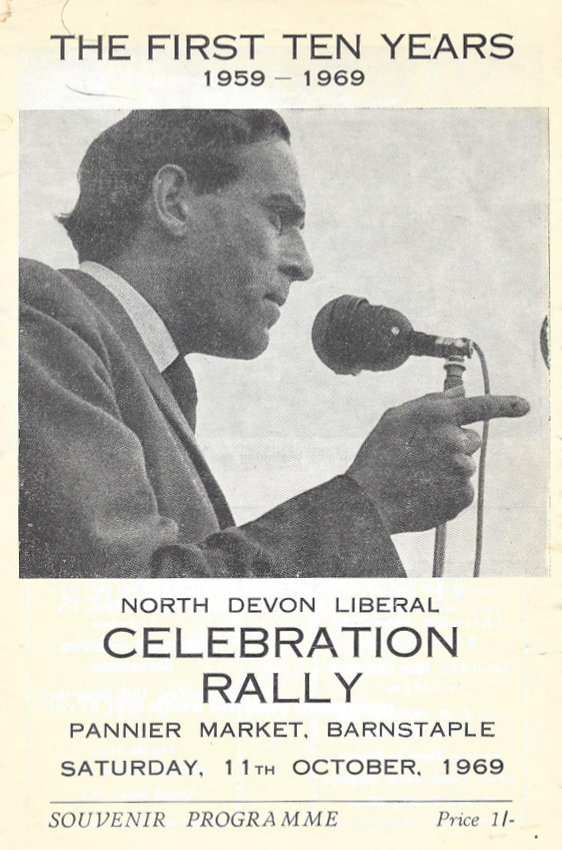
Historian Garry Tregidga argues that Jeremy Thorpe’s victory at North Devon in the 1959 General Election ‘confirmed the return of the Liberals as a credible force’. Thorpe, who was also to become Leader of the Liberal Party (1967-79), proved to be a skilful and charismatic candidate for North Devon. By 1955 he had visited every town and village in the division, while even Labour and Conservative activists admitted that on ‘sheer personality and swift answering of questions he was streets ahead’ of their own candidates. You can hear Liberal Councillor David Verney discuss the role Thorpe played in galvanising the Party below .
Under Thorpe’s leadership local Liberals were spurred into action. By May 1959 the Liberal Party in North Devon had thirty-seven branch associations, compared with only six in 1955. Party membership had increased to nearly four thousand in the area by 1960. In this clip, David Worden discusses how he helped build this local organisation.
Presenting themselves as the free and independent champions of local interests was a crucial factor in the future election success of the Party. Thorpe and his counterparts presented a distinctive alternative to the perceived indifference of central government by combining policies like regional development with measures to tackle the cost of living that directly impacted upon local farming communities. Thorpe remained MP for North Devon until 1979. At this time Thorpe was embroiled in a scandal which saw him tried, and acquitted, of conspiring to murder Norman Scott. Scott had claimed to have had a homosexual relationship with Thorpe in the 1960s, when this was still illegal in Britain. Thorpe eventually lost the leadership of the Party and his seat. The consituency moved to a Conservative majority for the next thirteen years, until Nick Harvey won the seat for the Liberal Democrats in 1992.
Further Reading
Garry Tregidga, The Liberal Party in South-West Britain since 1918, University of Exeter Press, 2000.
